
Do dog cooling mats work, and how?

Tessa Larkin · Writer, pet wellbeing and pet gear
Tessa lives with a Labrador and two cats on the Texas Gulf Coast, one of the hottest and most humid corners of the country in summer. For several seasons she has been testing, in real conditions, what actually helps animals through the heat and what only looks like it does.
Start with the problem: your dog cannot sweat
We humans have over two million sweat glands in our skin. When we get hot, sweat evaporates, carries heat away and cools the body. It is a highly effective system, and it is why we can stand 95 °F.
A dog does not have that system. Its few sweat glands sit in the paw pads and make almost no difference. That leaves panting: breathing fast and shallow so moisture evaporates from the tongue and airways. It works, but it costs effort, and it works worse and worse as the air gets humid. In muggy weather it is the first route to close.
That leaves a second route, the one people forget: shedding heat through the underside of the body, where the coat is thin and the skin meets the floor. It is exactly why dogs take themselves off to the tile, the bathtub or the basement floor in summer. They are not looking for cold, they are looking for a surface that will absorb their heat.
A cooling mat is nothing more than that kind of surface, only better at it and portable anywhere.
The physics, in one paragraph
Two things decide how cool a surface feels: its temperature and its thermal conductivity. The second one is the interesting part. The wood and the tile in your living room are at the same temperature, yet the tile feels cold and the wood does not. The reason is that tile pulls heat out of your hand far faster.
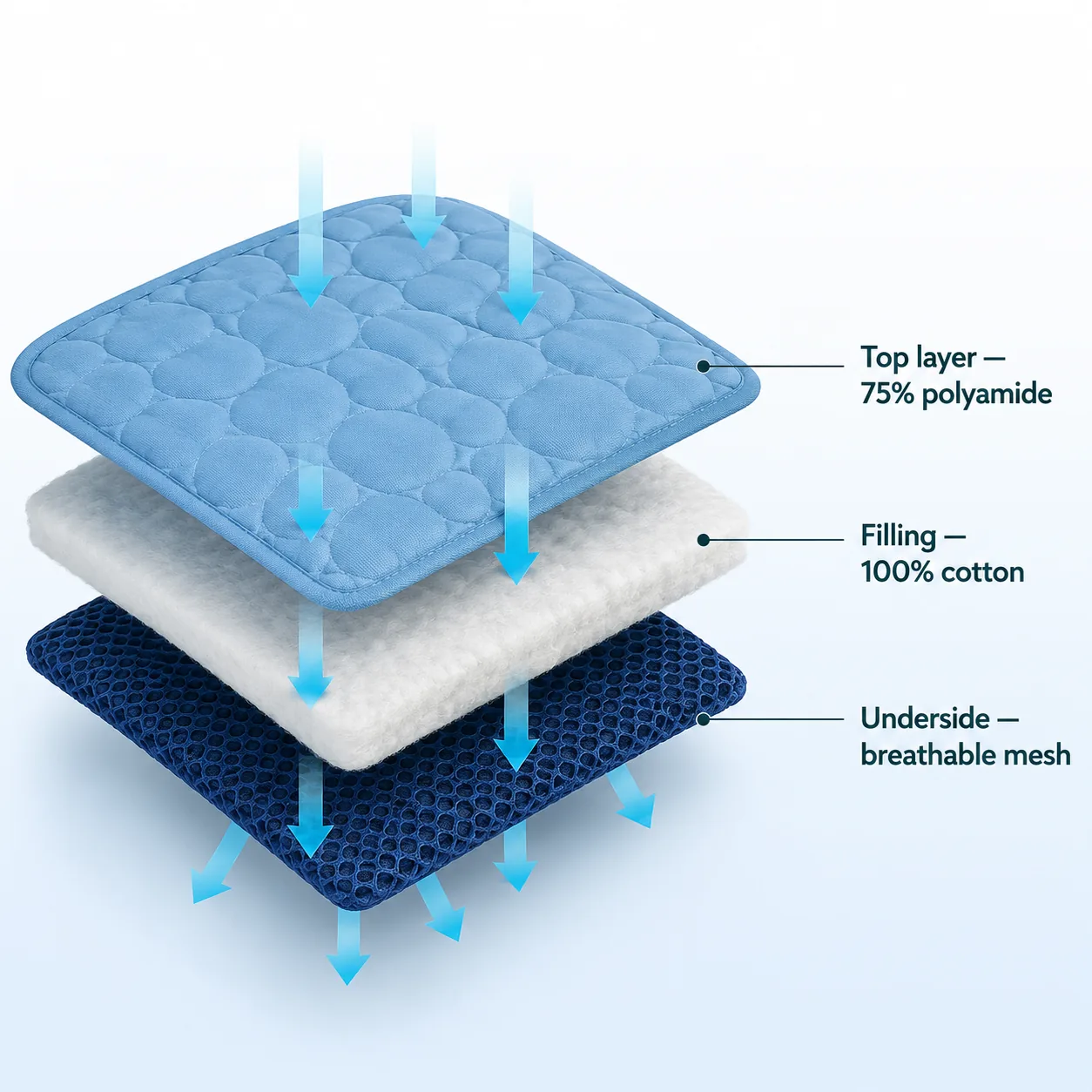
Fabrics behave the same way. Cotton and polyester conduct heat poorly, which is why a blanket keeps you warm. Polyamide conducts it markedly better, so a fabric with a high polyamide content feels cold to the touch even at room temperature. That effect is exactly what gave the fiber its trade name: ice silk.
Our mat puts that to work where it counts:
| Layer | Material | What it does |
|---|---|---|
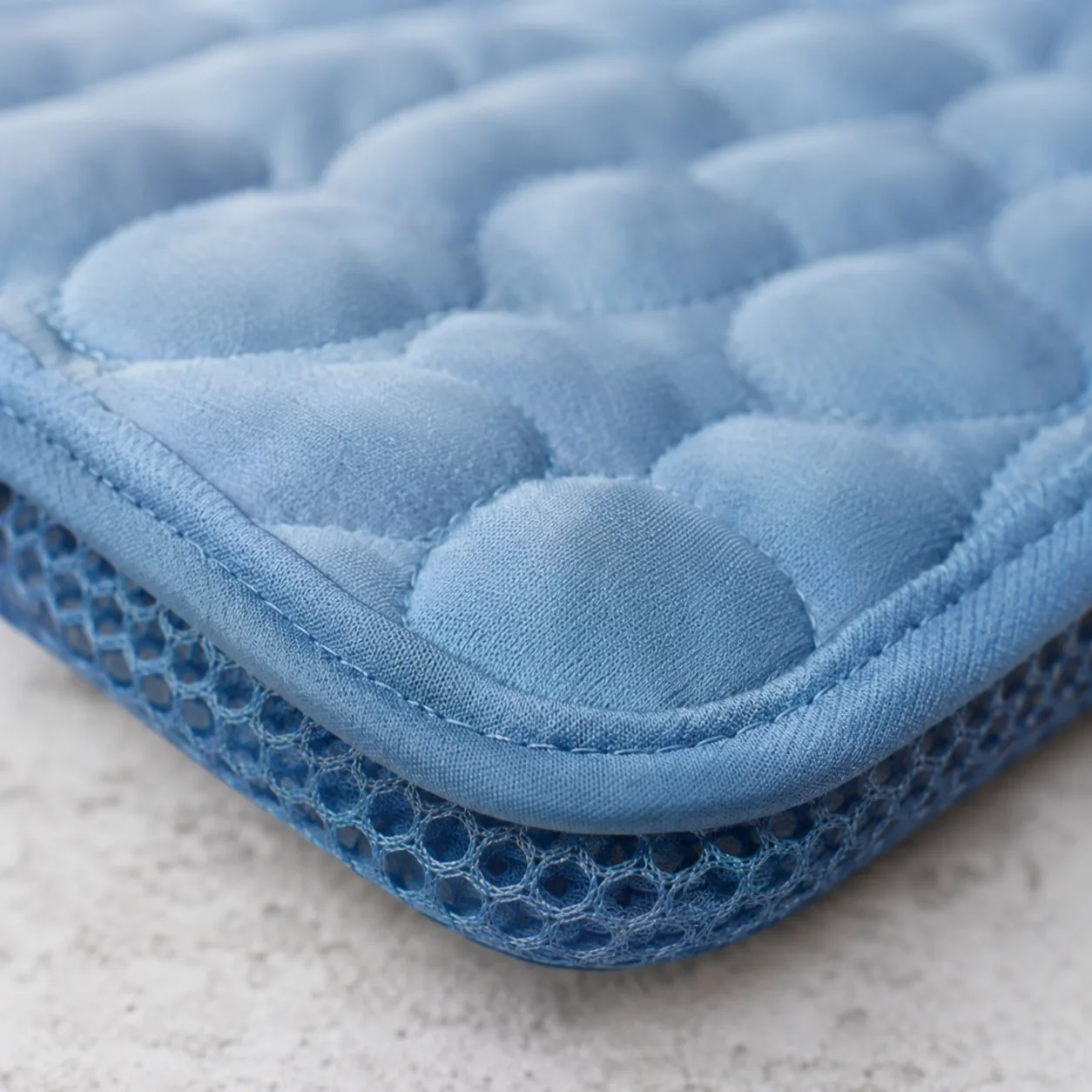
| Top layer | 75% polyamide, 25% polyester | takes up body heat and spreads it out |
| Filling | 100% cotton | cushions without blocking conduction |
| Underside | 100% polyester | breathable mesh, lets the heat out |
Read off the label of an actual unit. Not "polyester" as a word: the percentages, because the same word covers fabrics that behave completely differently.
The result: measured, not claimed
“But does it actually work?” is the most asked question on every market we sell in. There is only one way to answer it, and that is with a number. We measured with an infrared thermometer: first the bare floor, then the mat surface, in the same room at the same ambient temperature.
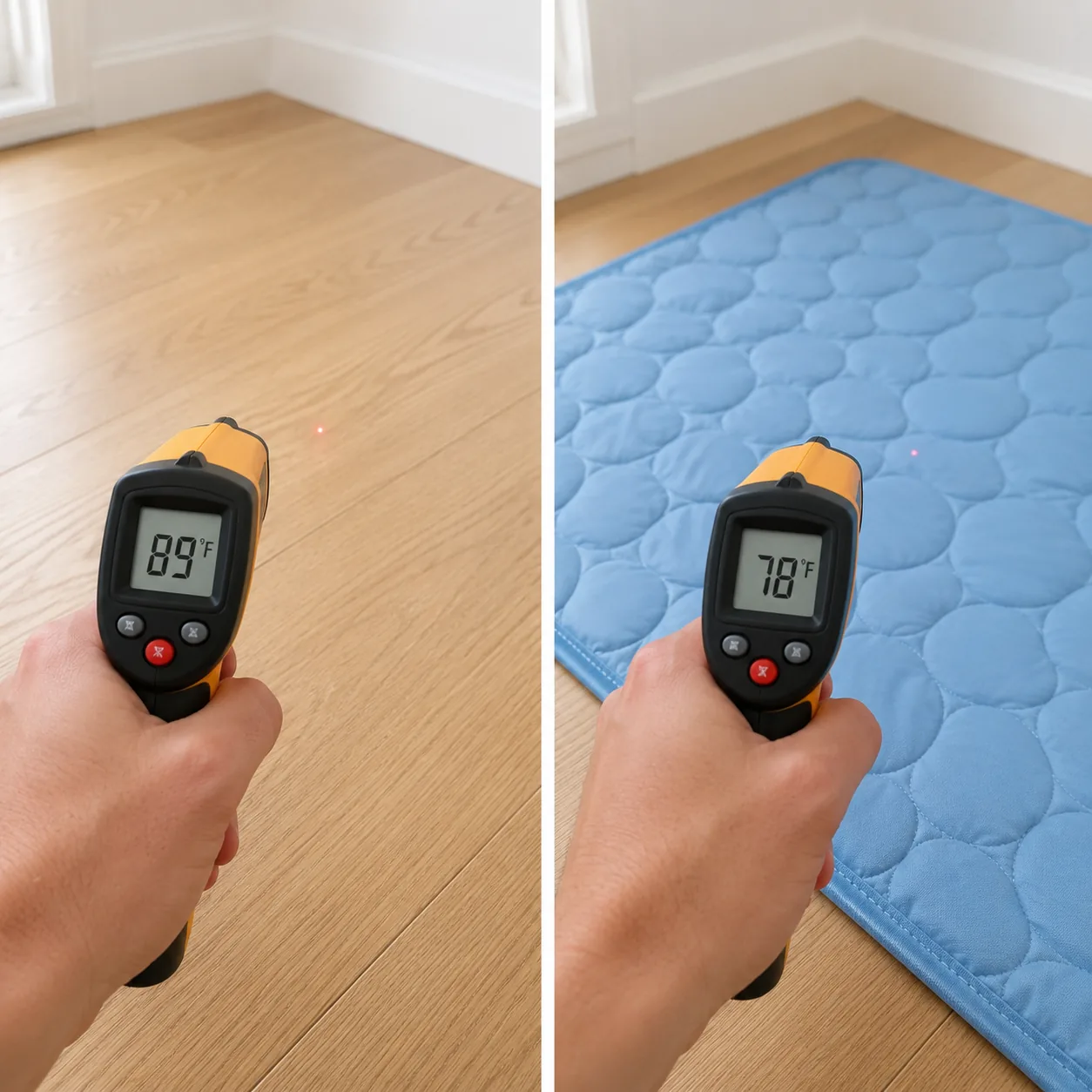
About eleven degrees of difference on the same floor, in the same room, with no power and no preparation. For comparison: claims like “up to 10 degrees cooler” appear on several listings, almost always without saying what the measurement was taken against. Without a starting figure, a number of degrees is not information.
The limit that applies to every passive mat, ours included. No mat without a power supply can go below the temperature of the room it is in. It takes heat up until it reaches equilibrium with its surroundings; it cannot hold a body below room temperature. The appliance that does that is an air conditioner, and it draws current.
So the Frimouf Ice never gets colder than the room. The 78 °F measured above is the surface in a room at ambient temperature, not a figure that keeps dropping. What it was cooler than is the floor, at 89 °F, which the room and the sun had been warming. That is the comparison worth making, and it is the one we published.
It also matters to understand what that number does not mean. It measures the surface before the animal lies down on it, not the dog’s body temperature an hour later. A mat does not bring down a fever and it does not prevent heatstroke in a car. It gives a dog a surface to shed heat into, and that is exactly what it does, no more and no less.
Why it fades after a while, and why that is not a fault
It is the second question that comes up everywhere, almost in the same words: how long does a dog cooling mat last?
The honest answer is: for as long as the heat can flow away. If the dog stays still in the same spot for a long time, the fabric there warms to their temperature and the difference the whole effect depends on disappears. The moment they get up or turn over, that surface is cool again within minutes.
That is the big difference from gel or freezer mats: there the reserve runs out sooner or later and has to be recharged. This is not us saying so to sell you something, it is written on the listings themselves: "guarantees a duration of 3 to 4 hours of constant use", after which the mat has to be left unused so the gel can regenerate. On a 91 °F day, three or four hours covers the afternoon and that is it.
Here there is no reserve, so there is nothing to regenerate and no break to respect. The effect comes back on its own as soon as the dog shifts, all summer, and the summers after that.
Which is why, in practice, a bigger mat turns out more useful than one worked out to the inch: on a surface where the dog can move, there is always a cool patch to find. Which size matches which weight is explained in the size guide.
Four technologies, four ways of working
"Cooling mat" in a store covers four fairly different products. They do not work the same way and they do not fail the same way.
| Technology | How it cools | Where it hits its limit |
|---|---|---|
| Ice silk | conducts body heat away, continuously | does not go below room temperature |
| Gel | pressure-activated gel absorbs heat | escapes if the animal chews it; warms up and needs breaks |
| Water-filled | the mass of water stores heat | filling, weight, leaks, mold |
| Freezer type | gives back the stored cold | takes up the freezer, goes stiff, can be too cold |
The worry about gel is not something we invented. People search for "gel cooling mat for dogs" convinced that is the right product, and at the same time others search whether gel is dangerous for pets. What is true and what is not is explained on the page about the gel-free cooling mat.
How to spot a cooling mat that works
Three things tell you more than any amount of sales copy.
Is the composition written down? If a seller will not say what the top layer is made of, in percentages, they cannot explain why it should cool either. The word "polyester" on its own tells you nothing: the same word covers fabrics that behave completely differently.
Is the surface big enough? An animal that only half fits only half cools. Read the inches rather than the letter, because what is an L for one seller is already an XL for another.
Will the seams hold? Claws are the usual reason a mat is fit for the bin after one summer. On a product an animal kneads and scratches, how the seams hold matters as much as the performance.
Those three are the most important, but not the only ones. The full list, along with what a "best tested" badge actually means, is on the page about how to choose the best one.
Frequently asked questions
Do dog cooling mats actually work?
Yes, and by heat conduction rather than magic. The top layer is 75% polyamide, a fiber that carries heat far better than cotton or polyester. When your dog lies down, body heat moves into the fabric, spreads across the surface and out through the mesh underneath. The mat does not make cold: it takes heat away.
How can they work with no power at all?
They do not need power because they do not chill anything. An air conditioner or a fridge spends energy actively moving heat. An ice silk mat uses a temperature difference that is already there: your dog sits at 100 to 102 °F, your floor at 68 to 86 °F. The mat makes that gap usable.
How long does the cooling really last?
For as long as heat can flow away. If your dog stays still, the temperature underneath evens out and the effect fades in that spot. The moment they get up or turn over, the surface is cool again within minutes. Nothing runs out and there is nothing to recharge.
Do I need to chill it before use?
No. No freezer, no fridge, no water. It works straight out of the box, from the moment your pet lies down on it.
Does it still work at 95 °F?
Less well, and it is only honest to say so: that holds for any passive mat. The closer the room gets to body temperature, the less heat can flow away. In extreme heat the mat is one element alongside shade, moving air and fresh water, not the whole answer.
How does a cooling mat work for cats?
Physically it is identical. The difference is behavioral: a cat picks its own spot and often only settles after a few days, once the mat smells familiar. We cover that on the cat cooling mat page.
The physics, in four sizes
75% polyamide on top, cotton filling, breathable mesh underneath. No gel, no power, no freezer.
Free shipping to 18 countries · 30-day returns · We reply within 24 hours